Lift
The wings turn the air downward, and the air pushes back up on them. No motion, no lift: it needs to be moving.
A paper plane is the simplest glider there is. Your throw gets it going; after that it trades height for speed, and its wings turn the air to hold it up. Throw one below and watch the forces at work.
Change how hard you throw it, how big its wings are and how much its nose is tipped up, then let go (or tap the sky). Earlier flights stay behind, faint, to compare.
liftdragweight
A plane with an engine has four forces on it. A paper plane gets its push from your throw, and then it’s a glider: just three, and it trades height for speed.
The wings turn the air downward, and the air pushes back up on them. No motion, no lift: it needs to be moving.
Gravity, pulling it down. A plane turns about its centre of gravity, so where its weight sits decides how it flies.
The air pushing back as it moves through it. It’s what slows a plane down, and why it can’t glide for ever.
A real wing is curved. A paper plane’s is flat, and still flies: its nose is tipped up a little into the air, so the wing meets it at an angle and turns it downward. That angle is the angle of attack. More angle, more lift, up to a point (in the lab, about 15°; real planes vary); past it the air can’t follow the wing, lift falls away, and it stalls. Try the nose slider in the lab.
Air can’t get through it: a sheet is layer upon layer of fibres locked together, so the air has to go round, and pushes on it as it does. And it’s light, stiff enough to hold its shape, and holds a crease, and a bend at the back of a wing to trim it.
A paper plane’s centre of gravity is a little ahead of where its lift pushes, so its nose wants to drop. Bending the back edges of the wings up or down is how you balance that.
Bend the back edges of the wings up a little. That lifts the nose.
It’s stalling. Bend the back edges of the wings down a little.
Check the wings match first. Still turning left? Bend the back edge of the right wing up a little (and the other way round).
Pick one: it’s on the stand. Throw it, and it takes off over this page; catch it, throw it again, or call it back.
The Dart is on the stand. Throw it, and see how it flies.
An American children’s book from 1864 describes how to fold a paper plane: as far back as anyone has traced them.
Jack Northrop, a co-founder of Lockheed, built flying paper models to try out designs for real aircraft.
Aeronautical engineer Ken Blackburn kept a paper plane up for 16.89 seconds, on his third try. He held the time-aloft record on and off until the late 1990s, ending at 27.6 seconds in 1998.
Red Bull Paper Wings began: a world championship of paper planes, for distance, hang time and aerobatics, with the finals in Hangar-7 in Salzburg.
The PARIS project lifted a paper plane under a balloon to almost 90,000 feet and let it go to glide back down.
John Collins designed it, Joe Ayoob threw it: 69.14 m inside a 747 hangar at McClellan Air Force Base.
The paper airplane was inducted into the National Toy Hall of Fame in the United States.
Three engineers’ design, inspired by hypersonic vehicles, flew 88.31 m: a new distance record.
In December, Liu Liwen and a team of five set the distance record at 98.43 m (322 ft 11 in).
In February a team of seven kept a paper plane up for 31.2 seconds. In June, students in Bologna flew the largest paper plane ever made: 20.04 m from wingtip to wingtip.
 The 2012 world record throwThe Paper Airplane Guy (John Collins)Joe Ayoob throws Suzanne 69.14 m.
 How to fold the world record paper airplaneThe Paper Airplane Guy (John Collins)Suzanne, folded by the man who designed it.
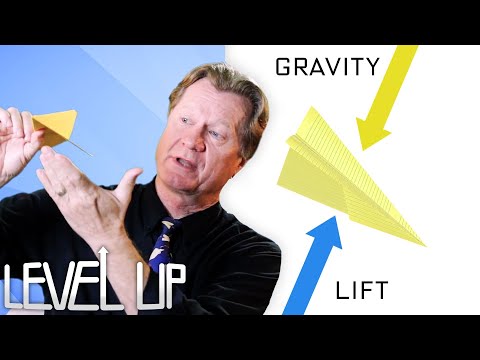 Aerodynamics explained by a world record paper airplane designerWIREDHow a paper plane flies, from the man who designed one that held the world record.
 Four forces of flight with paper airplanesU.S. Space & Rocket CenterThe forces, shown with paper planes.
 Takuo Toda’s 29.2 second flightTHE SKYKINGA paper plane that just won’t come down.
 Kim Kyu Tae’s 77 metre throwGuinness World RecordsThe distance record from April to December 2022.
 Red Bull Paper Wings 2015Red BullThe paper plane world championship.
 Ken Blackburn’s record flightKen BlackburnFrom the engineer who held the time-aloft record.