Paper Plane

Paper Plane Academy › Paper airplane launcher

How to make a paper airplane launcher: a rubber band slingshot

A rubber band throws a paper plane far faster than your arm can. Fold a dart, clip a paper clip under its nose with the straight end pointing back, and loop a rubber band over a pencil. Hook the plane on the band, pull it back, aim a little upward and let go. If it loops, flatten its back edges.

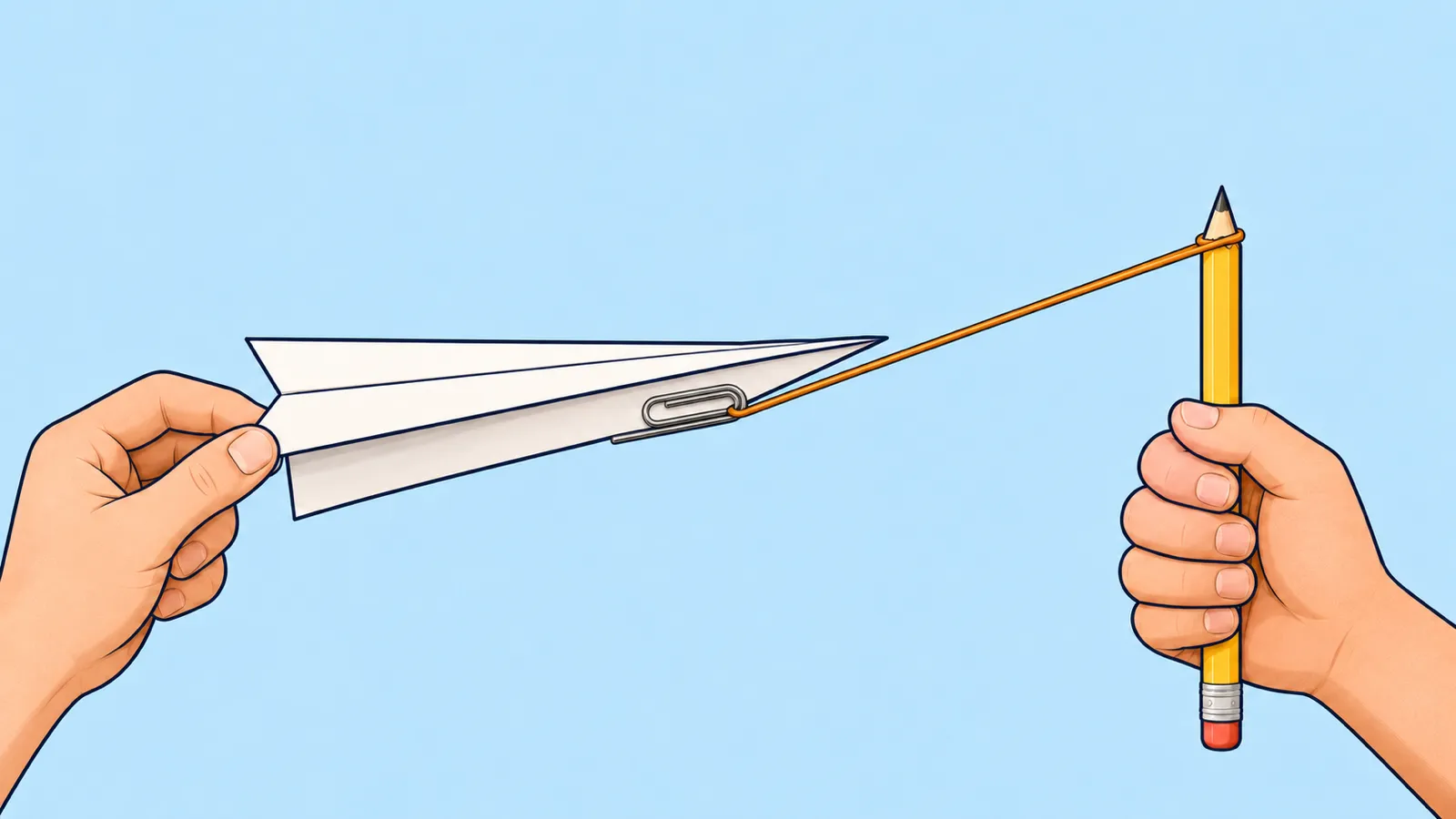
A paper dart launched with a rubber band: one hand holds a pencil upright with a rubber band looped over its tip, stretched back to a paper clip under the dart’s nose; the other hand pinches the dart’s tail and pulls it back.

Paper Plane Academy · Checked 21 November 2026

What you need

1. Fold a plane that can take the speed

A band launches a plane much faster than a throw. A slim dart paper airplane goes faster and farther; wide gliders make so much lift at that speed that they loop the loop. Fold one of these, and flatten the back edges of its wings.

2. Give it a hook: a paper clip under the nose

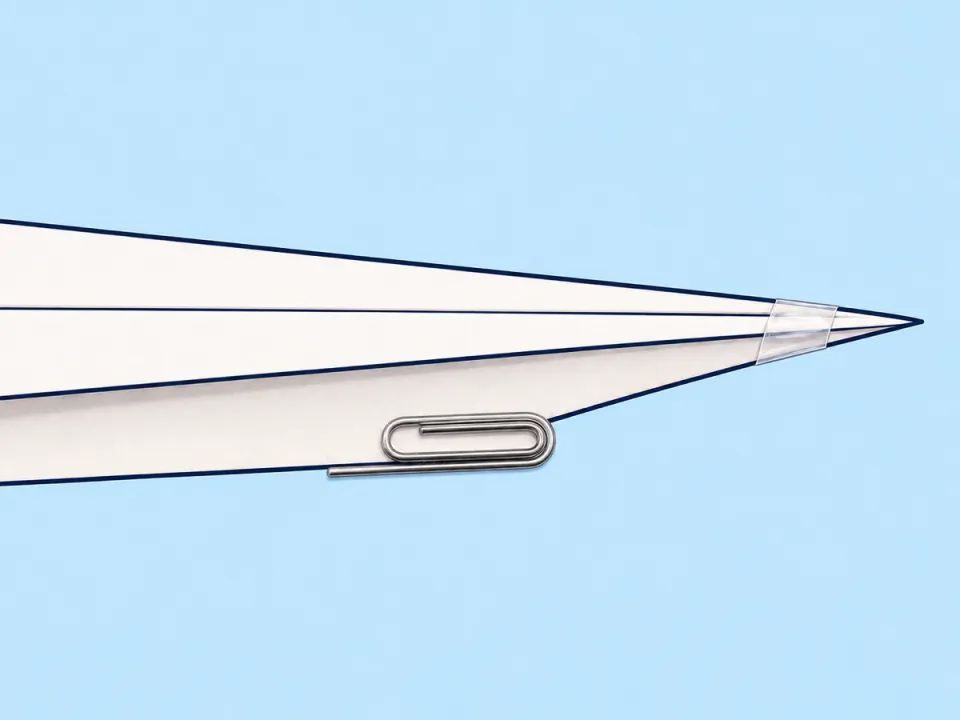
The front of a paper dart from the side, nose to the right: clear tape wrapped round the point, and a paper clip slid onto the bottom edge of the keel just behind it, its outer straight leg sticking out under the keel and pointing back toward the tail, a hook open toward the tail.
Tape round the point first, then the clip on the keel, about 2 to 3 cm behind it, its straight leg pointing back.

Wrap a strip of tape round the nose. Then slide a paper clip onto the bottom of the keel, just behind the point, so its outer straight part points backward, along the bottom of the plane. That straight end is the hook: the band slips in under it from behind and pulls the plane forward.

The band pulls hard on it, so it has to be secure. Scientific American’s launcher tapes or staples the clip to the nose (Build a paper airplane launcher, Science Buddies). Maker Camp pokes a bent clip through the keel about an inch (2.5 cm) back from the nose and glues it inside (Paper airplane launcher).

The clip adds weight to the nose too. That’s no bad thing: a launched plane wants a steady, slightly heavy nose.

3. Make a launcher: three ways, simplest first

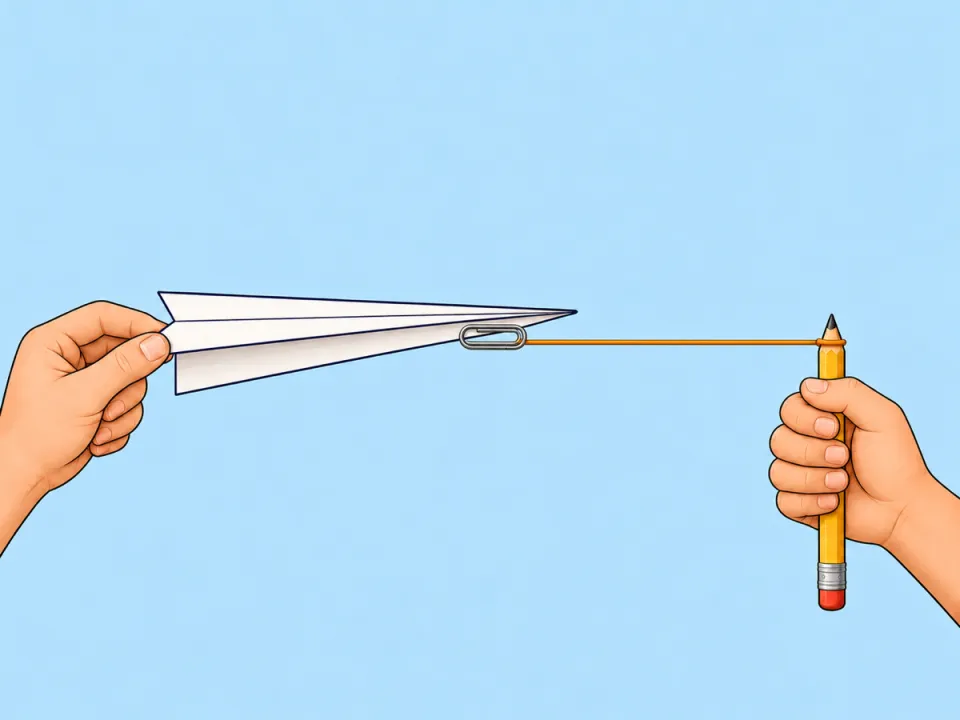
The pencil launcher from the side: a hand holds a pencil upright, a rubber band looped over its tip runs back to the paper clip under a dart’s nose, and the other hand pinches the dart’s tail and pulls it straight back.

A pencil and a rubber band

Loop the band over the tip of a pencil and hold the pencil upright, out in front of you. Hook the plane’s clip on the other end of the band, pull back, aim forward and let go. It’s the launcher Science Buddies teaches to start with: ready in a minute.

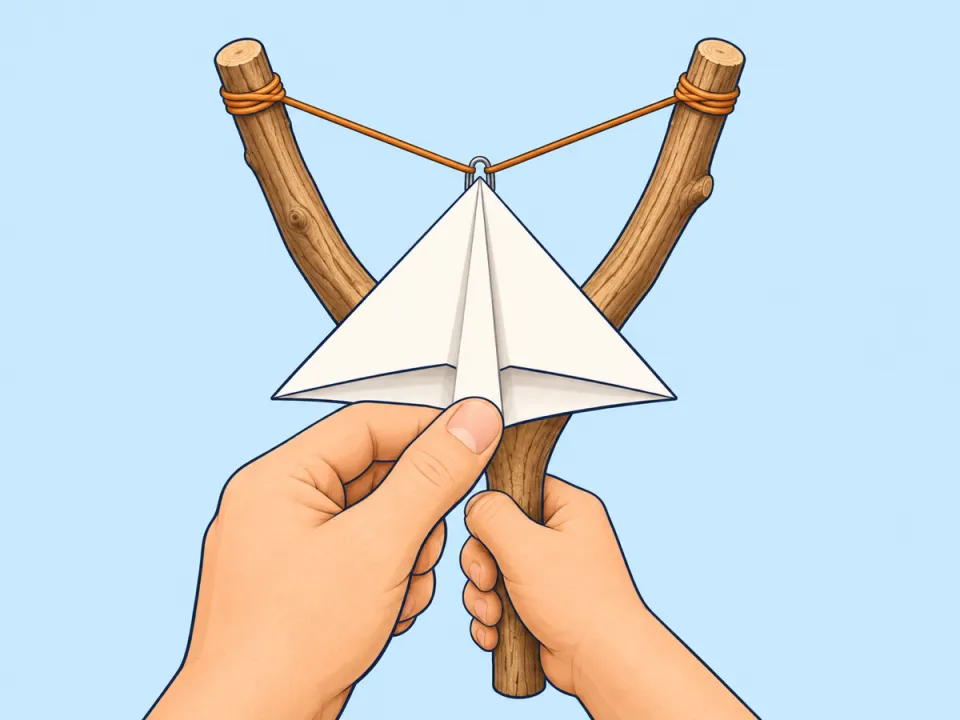
A forked-stick slingshot from behind: a wooden Y held upright, a rubber band tied between its two tips, and a paper dart hooked by its nose on the middle of the band, pulled back between the prongs by a hand at its tail.

A slingshot: a forked stick, or two nails in a board

Stretch a big rubber band between two posts with room for the plane to fly out between them. Maker Camp hammers two nails into a board, about an inch from the edge and standing at least 2 inches proud (its steps); a forked stick held upright does the same in your hand. Pinch the plane under its wings, hook it on the middle of the band, pull it back toward you, and let go.

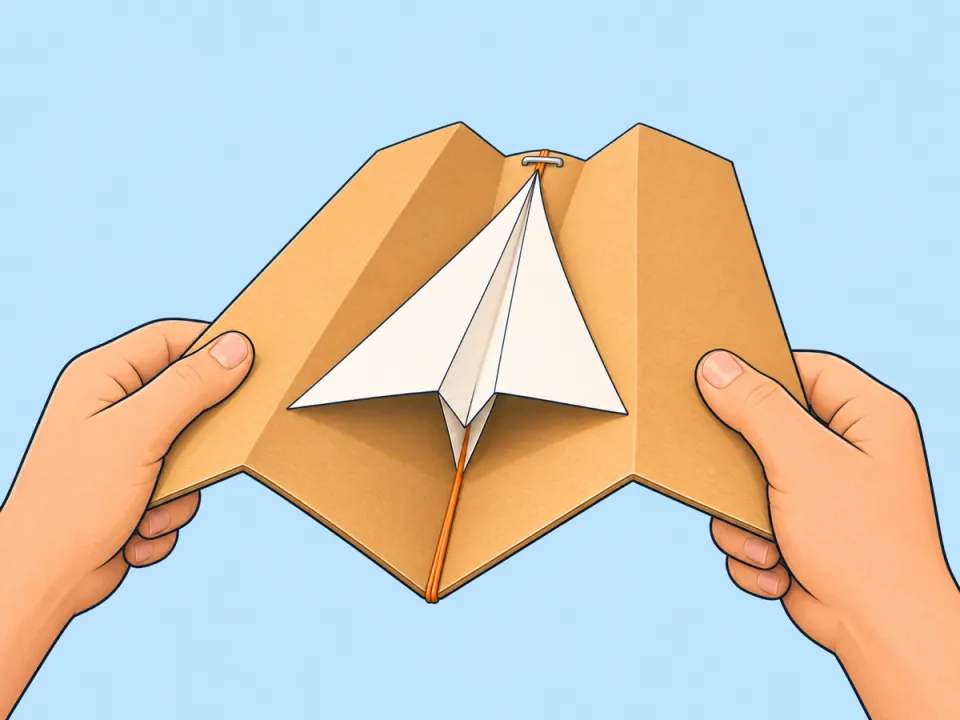
CSIRO’s card launcher: a square of card folded into an M, a paper dart sitting keel-down in the middle crease with its nose toward the far end, a rubber band stapled at that end and stretched back along the crease behind the dart, and two hands holding the outer flaps, ready to pull them apart.

A card launcher: no hook needed

From CSIRO’s Double Helix: fold a 20 × 20 cm square of card in half, then each side in half again, so it makes an M. Staple a thin band near the middle crease at one end, stretch it back and hook it over the far end. Sit the plane in the middle crease, nose toward the staple, hold the outer flaps and pull them apart: the band snaps forward and pushes the plane out.

4. Hook it, pull it back, aim, let go

levelabout 10 to 20° uptoo steep: it loops or stalls
Level to about 20° up. Steeper, and it climbs, runs out of speed and drops short.
  • Hold the launcher stillAt arm’s length, in front of you, out of the plane’s way.
  • Pinch near the tailPull the plane straight back, level with the band, wings flat.
  • Aim a little upLevel to about 20°. Away from people and animals, always.
  • Let go of the planeJust open your fingers. Pull back further each time, and stop before it loops.

Play: a paper plane slingshot

Try the aim on screen first. Drag the plane back out of the slingshot and let go, or use the sliders. Then try the glider, or bend its back edges up, and see what a launch does to them.

Plane
Back edges

    A simulation: the glide lab’s physics for an A4 dart, launched from chest height, in still air. Real flights vary; the lessons hold.

    Why a launcher throws it so far

    A stretched rubber band stores energy, and it gives all of it to the plane in a few centimetres: “it stores potential energy, which gives extra kinetic energy (motion energy) to the paper airplane,” as Scientific American puts it. Your arm can’t move that fast over so short a distance.

    Speed is lift: a plane twice as fast makes four times the lift (see it in the glide lab). That’s why a launched plane climbs, and why one with wide wings, or its back edges bent up for a gentle hand throw, makes so much lift that its path curls into a loop. A launcher wants a slim plane trimmed flat.

    If it loops, dives or veers

    It loops or flips over

    Too much lift for its speed. Flatten the back edges, or bend them down a hair; pull back less; aim lower. Or fold a slimmer plane.

    It dives into the floor

    The clip may be too heavy for the plane. Bend both back edges up a little, or use a smaller clip, and aim a touch higher.

    It veers to one side

    Make the wings even, and pull back straight, in line with the band. A twisted pull twists the plane. More fixes.

    The hook tears out

    Tape round the nose before the clip goes on, or fold the Heavy dart: its nose is thicker.

    Launch it safely

    Questions

    How do you make a paper airplane launcher?

    Fold a dart, clip a paper clip to the bottom of its nose with the straight end pointing back, and loop a rubber band over the tip of a pencil. Hook the clip on the band, pull the plane back and let go. Scientific American teaches this one.

    How do you launch a paper airplane with a rubber band?

    Hold the launcher (a pencil, a forked stick or a board with two nails) out in front of you. Hook the plane’s clip on the middle of the band, pinch the plane near its tail, pull it straight back, aim a little upward and let go of the plane, not the launcher.

    Which paper airplane is best for a launcher?

    A dart: slim wings, a sturdy nose and a keel to hold the clip. Wide-winged gliders make so much lift at launch speed that they loop. The Heavy dart and the Arrow work well too.

    Why does my paper plane loop or flip when I launch it?

    It’s going so fast that its wings make far more lift than it weighs, and its path curls over. Flatten its back edges (or bend them down a hair), pull back less, and aim lower.

    Can you make a paper plane launcher with no hook on the plane?

    Yes: CSIRO’s card launcher folds a square of card into an M. The plane sits in the middle crease, and the band pushes it from behind when you pull the flaps apart.

    Is a paper airplane slingshot safe?

    Safe enough with care: it launches paper, but a fast paper nose or a clip can still hurt an eye. Never aim at people or animals, launch in an open space, and don’t stretch a band until it’s near snapping.